Aging Brain and Panic Button What Seniors in Canada Need to Know
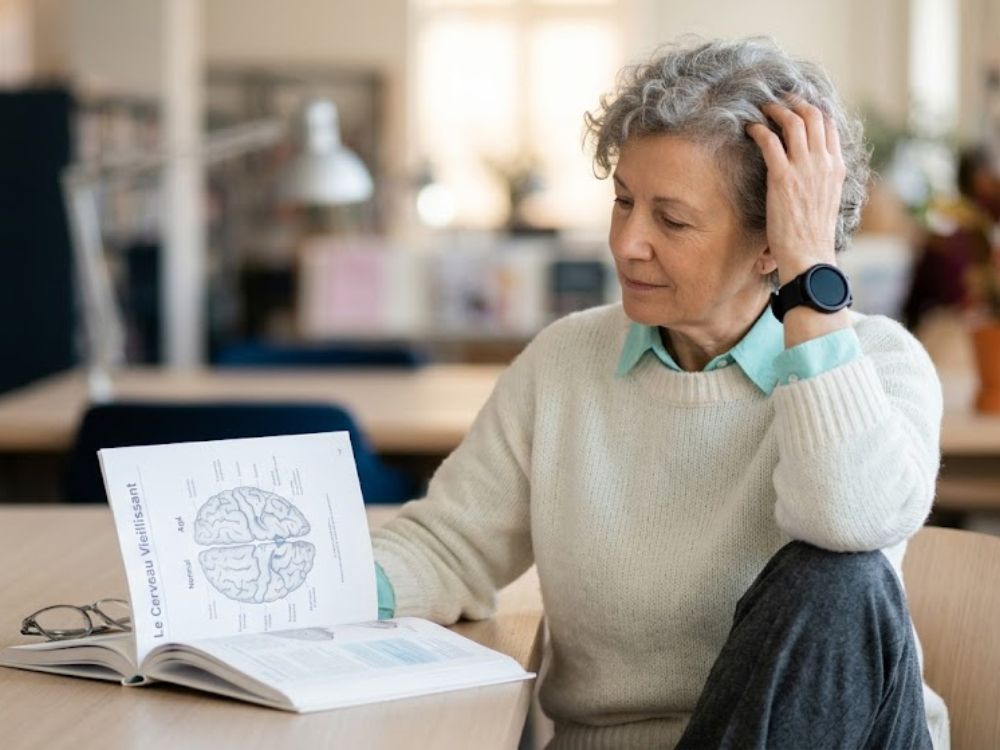
You're searching for an old friend's name and it escapes you for three days, then surfaces while you're showering. Your mother forgets where she put her glasses, but recalls without hesitation an anecdote from 1962. An aging brain is not a brain in decline, it's a brain reorganizing itself. Understanding this distinction changes how you support an aging parent. And it happens to change how you choose the right daily tools for the retirees you love.
What actually changes in seniors' brains after 65?
Margot is 81. Last spring, she found her keys in the freezer. She laughed. She always stores her Earl Grey tea next to the frozen peas, so why not. A librarian for forty years, she kept the habit of organizing things according to her own particular chaos.
After 65, the brain loses some volume, mostly in two zones. The hippocampus, which manufactures new memories. The prefrontal cortex, which organizes and retrieves information quickly. This is why proper names and phone numbers become temperamental. Yet semantic memory, the accumulation of knowledge, and procedural memory, the kind that knows how to drive or play piano, remain stable or even deepen. So forgetting a word and then retrieving it ten minutes later is a sign of normal function. By contrast, forgetting the entire event, failing to recognize a familiar face, or becoming lost in a known neighborhood, these are different things, and they warrant medical attention. The simple rule neurologists use is this: worry when forgetting interferes with daily life, not when it embellishes it.
How does an emergency alert device protect a normally aging brain?
That spring, Margot took up tai-chi in Outremont Park. She says it forces her to breathe in the right sequence. She also ordered a book on Quebec mushrooms she hasn't opened yet. Her daughter Lea gave her a small alert pendant she wears over her mauve scarf. Margot thinks it looks rather like strange jewelry. She accepted on one condition: it had to be waterproof, because she often forgets to check the weather and rain tends to find her anyway.
A cognitively healthy brain benefits from three protective habits that research has validated for twenty years. Regular physical activity, which increases cerebral blood flow and stimulates BDNF production, a protein that promotes the birth of new neurons. Deep sleep, which serves to clear metabolic waste through the glymphatic system, a kind of cerebral plumbing that activates at night. Social bonds, which activate multiple brain regions simultaneously and maintain cognitive flexibility. Moreover, getting out, moving, traveling becomes easier when an emergency alert device accompanies the older adult discreetly. That said, the point isn't to replace caution, but to remove a psychological brake. Walking alone in an unfamiliar neighborhood, setting out on a hike, traveling by train, these activities stimulate spatial memory and the SOS button simply makes them more accessible to aging people.
SmartSAFE PLUS, the medical alert system designed for the active older adult
The coming summer, Margot plans to hike the Mont-Royal trail alone, and take the train to Quebec City to see her sister. The SmartSAFE by SecurMEDIC is exactly the discreet companion she wanted. Lightweight pendant, IPX7 waterproof, advanced GPS paired with cellular and Wi-Fi positioning, two-way voice communication directly through the device, automatic fall detection, 24-hour monitoring available throughout Canada. No smartphone required, no long-term contract, free shipping. For older adults in their third age who want to keep their independence without giving up foresight, SmartSAFE PLUS is designed to disappear in daily life and appear only when it matters.